JUNE 25: A soft, billowy hanakobo nama from Hida-Takayama, and an assortment of our favorite Summer cups
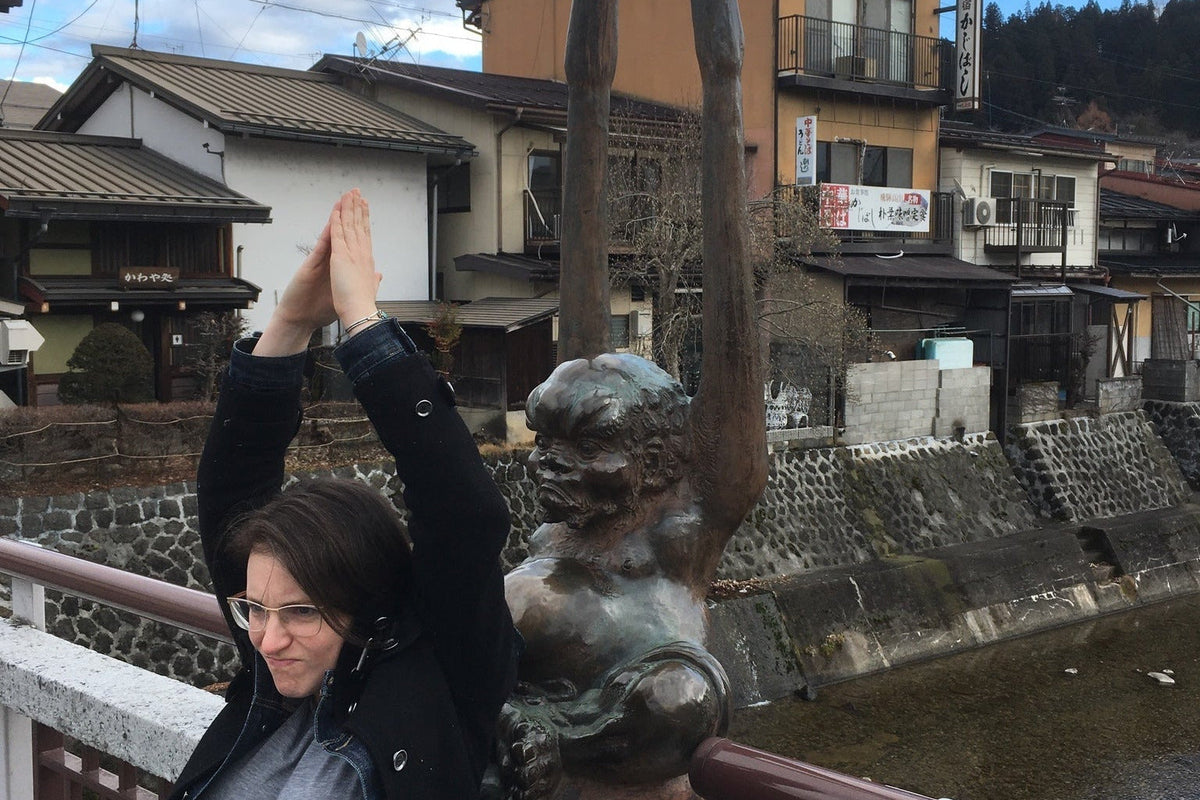
Having fun on the iconic bridges in Hida-Takayama, 2020
HIRASE SHUZO- KUSUDAMA JUNMAI DAIGINJO NAMA
Back when sake was just this totally innocent, fun distraction for me, when I was visiting Japan in January 2020 with the primary goal of tourism and wine study (yep, Japan makes some awesome wine) my husband and I spent a few days in the incredibly charming Hida-Takayama village. Roughly~ 1.5 hours by (slow, local) train from Nagoya, you wind north along the Hida river, up through the mountains, to this isolated mountain town, once a major stop on the Nakasendo inland road from Edo to Kyoto.
The theme this month is, principally, pairing exploration: that’s what we spent a big chunk of time on, so I’m not going to go too deep into the weeds here. But I have really fond memories of this place: the bountiful morning farmer’s market, the abundant handicrafts, the wagyu sushi, and sesame-slathered mochi on a stick. It’s one of my favorite places in Japan, even today, even after the huge amount of exploration we’ve done. I guess you never forget your first Japanese mountain village.
That trip, we brought two bottles of Kusudama sake home. Their tasting room is located on the main drag: a small commercial area in the center of Takayama, and sheerly out of luck we happened to be staying in Takayama during one of their sake festivals/open house weekends, when visitors are encouraged to check out the local breweries and are provided with English maps, information, and stampable passports. According to my notes, the sake of Hirase Shuzo (established 1623) was “smooth and delicious”-- “ a little bit herbal or tea-like.” We’ve carried their “sarubobo” Tokubetsu Junmai cup for years, for me a tasty little homage to this special place, but we’ve never been offered anything else until now. Brand-new to the US, this junmai daiginjo nama– highly polished, top class, unpasteurized sake– immediately struck Molly and I as unique. From its super-soft texture to its complex, tight finish, its generous tropical and floral aromas, this sake is really something. It reminds me a little bit of the “Space Yeast” junmai daiginjo we shared last month, because they’re both tropical, slick on the palate, and have a very out-of-the-ordinary aromatic profile. But it’s still different…it’s more round and soft, like a silk pillow. And it has these very lofty aromatics, but with a contrasting astringent note on the finish that begs for a food pairing. It suggests the bitter cold of the mountain, as well as the wild Spring vegetables and gently bitter ayu, river sweetfish, famous in Hida-Takayama. Or anyway, that’s what the brewery owner recommends to pair with it.
Data:
-
Brewery: Hirase Shuzo, est. 1623 (15th generation)
-
Location: Hida Takayama, Gifu
-
Rice: Hida-Homare, a local sake rice adapted to the mountain cold, “slightly bitter and astringent, crisper mouthfeel than others”
-
Polishing: 50%
-
SMV: +1
-
Acidity: 1.9
-
Yeast: Abelia flower yeast
-
Starter method: sokujo
-
Water: Very soft subterranean Japan Alps water
-
ABV: 15.5%
Soft, billowy, like a precious delicate smooth bubble on the tongue. Soursop, honeysuckle, green apple and strawberry, a bit of anise, fleshy, pastry cream, vanilla, pandan, a butter emulsification, luxurious, velour, flavored meringue, rice crispies, cereal marshmallows. The finish shifts into an astringent, satisfying, crisp and quick end that cleanses the palate and begs for another nibble of something salty.
Pairing and Storage
We’re letting Marie take the reigns on pairing this month, but I recommend looking at the advice for #3, Houou Biden Junmai Daiginjo, for clues on where to take this. Abelia yeast, a wild yeast isolated by Tokyo University’s Hanakobo research society from Abelia flower nectar, contains lots of Ethyl Caproate/Caproic Acid– this is where that generous bouquet and lightly astringent finish come from– as well as malic acid, the same acidity present in green apples. Hououbiden is fermented with a different yeast but one which produces the same compounds, particularly ethyl caproate, and is also highly polished, highly aromatic, and cold-fermented.
As for storage, this is a namazake. We recommend keeping it in the refrigerator, and enjoying within 6 months. If you open it 6 months from now, just know that it will be a little different (usually softer, a touch sweeter) than it is when it’s younger, due to the ongoing action of koji enzymes in the bottle.

ALL THESE CRAZY CUPS!
We had really positive feedback on our choice to include a selection of cup sake– single serving, 180ml bottles– in our seasonal club, so with two fresh cup arrivals we decided to do the same for you guys, too. This relates to our theme of playing around with pairing (why not set up your own little sashimi experiment? For that matter, you can use fresh mozzarella or fresh medium-firm ota tofu instead) but also, hopefully, encourages you to embrace little outdoor sake treats this Summer. SummerFall has quickly become Molly and my go-to for river time, while Funaguchi’s Shinshu Ginjo Green (made with fresh-harvested rice in Winter) is a beautiful fruit bomb that reminds me how good the simple things can be. Here’s a little rundown on each, and how you might enjoy experimenting with them.
Wakazake “SummerFall” Sparkling Classic
Confession time: I was a skeptic at first when these sparkling cans hit the market. Being produced at the enormous Takara Shuzo in Berkeley, what seemed like a mint spent on marketing and distribution to BevMo and other conventional channels, SummerFall didn’t feel like the thoughtful small-batch brews we focus on at Sunflower. But during a recent trip to LA I was able to tag along on a meeting between JETRO and Wakaze, who conceptualized SummerFall and explained the deeper inspiration behind the product. Most importantly, I finally tasted it– and while I didn’t love the yuzu flavor I tried before, I was totally sold on the classic.
Wakaze has a really cool background: it was the first Craft Sake brewery ever (more on that in July) established in Tokyo about 6 years ago. After burning hot and fast in Japan they opened up a brewery and tasting room in Paris, which I visited several years ago. It was at this time that I met the owner Takumi, who explained that he was looking to democratize sake and innovate by combining Japanese techniques with French camargue rice, super-hard Parisian water, and Burgundy wine yeast. I liked the flavor, but when it launched in the US at $35 on the shelf I have to admit I wasn’t sold. While the Paris brewery hums along happily, Takumi has shifted his focus to the US– in his words, the French market is too small to accomplish the widespread acceptance of sake he’s looking to achieve. So he worked with Takara to design a sparkling, affordable, single-serve canned sake, made with wine yeast, eco-friendly 80% polish rice (only 20% is removed, saving much of the grain), white koji (so no artificial lactic acid is added during brewing), and a fresh flavor profile that reminds Molly and I of sour cream cake with raspberries. It’s tart, refreshing, affordable and delicious. Not sure what I think about the marketing still, but…hey, if it’s good it’s good.
Look to the Senkin Modern (#5) and Ugo no Tsuki Usunigori (#6) examples in the article for potential leads on pairing.
Ohyama “Sakura” Tokubetsu Junmai Cup

One of my favorite seasonal cup sake, every year I get a soft assembly of delicate stonefruit notes, a bit of nutmeg or sweet spice, a kind of almond milk creamy texture, and a tranquil vibe that makes me want to lay down under a tree and bask in dappled sunlight. I had the pleasure of trying this cup when I was in Japan this March– I bought one to enjoy with my butter-shoyu dango at a hanami matsuri in Ueno Park, where I went shopping for vintage shuki to sell in the shop– and it was really like enjoying the sake as intended. Strolling through a cherry blossom festival, munching on buttery-salty dango, I was thrilled knowing that a few cases were headed my way in June.
This little cup is made with a blend of local Yamagata rice, Yamagata’s delicately aromatic and soft Yamagata-KA yeast, and polished to 60%. It’s a little bit old school in style, a little bit nostalgic with more umami and less acidity than you see at the hip bars. It has more in common with the Kuzuryu Ginjo (#3) or (Kikuyoi Ginjo (#2) than anything else presented here, but it’s probably also a little uncool or old-school for Marie to get into. If nothing else, I think you can just chill this down, bring it to the park with some crackers, cheese, and fresh fruit, and zen out for a while. Just don’t tell anyone I recommended you drink in public… (I said you should go somewhere it’s totally legal, right?)
Azuma no Fumoto “Nandemo C” Junmai Ginjo

Aside from SummerFall, I’ve been sending a lot of these little Nandemo C-- As you like it– Junmai Ginjo cups out with customers headed to the river, because of course when possible we shouldn’t be bringing glass to the beach/river/ pool, and particularly when hiking or camping it’s nice to spare yourself the heavy trash. This is also a brand new arrival to the US, and came into the shop in both 500ml and 180ml formats, with a handy temperature guide on the side. While it’s really the season for cool or room temperature sake, the design intent with Nandemo C is to encourage you to experiment with different temperatures. It was designed in tandem with the University of Yamagata fermentation science department (they work closely with this brewery) to express well at any temperature.
Molly and I have done a little experimenting and we totally agree: while we haven’t found any fireworks, it has a creamy, gently fruity-spice-warm rice milk taste warm/hot, a soft and simple, round flavor room temperature with a good balance of fruit and marzipan notes, and chilled you get a little bit of a sharper quality with more of the light fruit tones and a bit less of that round, cherry pit and sweet almond/almond flower. Does this remind you of Ohyama cup? It might! They’re both made from Yamagata yeast and rice, and they’re both very proud to be Yamagata-made.
Kikusui Funaguchi “Green” Shinmai Shinshu Honjozo Nama Genshu
Their first brew of the year, with a fresh batch of local Gohyakumangoku rice polished to 70% and a little bit of distilled alcohol added for lift and punch, this handy cup is a fruit bomb and a spiritual sibling to the rest of the Funaguchi series. Powerful as heck (18-19% ABV!), nama genshu (unpasteurized and undiluted), canned (great for water hangs), and proudly made in Niigata with all Niigata ingredients. This particular release, Green, is seasonally limited and becomes available in the US around May, selling out by mid-Summer. They call it their “sake nouveau,” but really, I think of it as the “fruity one,” while the others are a little more aged, malty, honeyed and grain-forward. Gold is the standard, first introduced in 1972 and pioneering the nama-genshu movement; black is the premium honjozo, made with Japanese rice shochu instead of imported 95% distilled alcohol, and red is the aged can, polished a little more (60% ginjo) and aged a year at the brewery before release (home aging of Funaguchi cans is pretty common practice). If they look retro, they are: Gold dates to 1972, and its design has not been updated. May it always stay the same! I love it.
Serve this COLD, or on the rocks– it’s too boozy to get away with much heat, which will make the alcohol more noticeable– and use caution, it’s like a little cocktail. I also enjoy it as a highball mixed with a bit of soda water. There’s something silly- sounding about pairing Funaguchi with anything but standard, low-brow Izakaya fare (gyoza, yakitori and potato salad sound about right), but if we were to look to Marie for guidance I’d look to Hanatomoe (#8) or possibly even Furosen (#9), particularly as Green rounds the corner into year two, or if you pick up a red can sometime. A little karashi hits the nose the same way that high ABV does here, and the salt and pepper recommendation for Hanatomoe is probably enough to bring out the prettier floral edges of Funaguchi.