JAN 25: Another Themeless January- A Watercolor ochoko chart, Kid Shiboritate cheese pairing, & Chochin's US debut
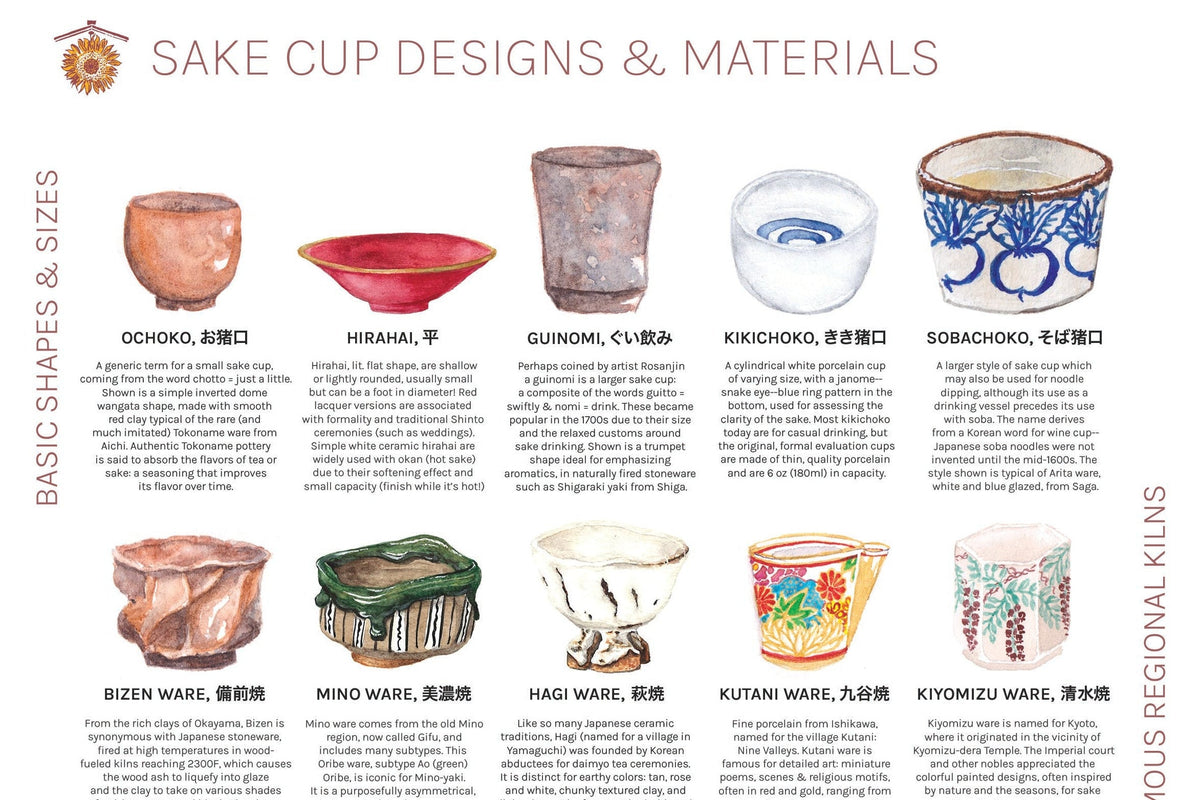

Sake cup sheet: PDF version, please use with credit to Nina Murphy, Sunflower Sake
SUNFLOWER SAKE CLUB, JANUARY 2025
ANOTHER THEMELESS JANUARY FROM THE HEART
For three years now, January has been more of a stream-of-consciousness club writeup. Last year I channeled my feelings about the Noto Peninsula earthquake with Hokuto Tokubetsu Junmai, and shared Tahoma Fuji Junmai Namagenshu after visiting their Seattle brewery with my Japanese friends Okan Lover (who will be back for this year’s Fuyu Fest). The previous year, I wrote a love letter to Akita...the first prefecture I ever fell in love with. I still love their sake dearly.
This January is a few years in the making, but it’s just as visceral. Straight from the heart.
We’ll return to our usual nerdy-technical-passionate educator selves in February with another set of super exciting and rare new arrivals :)

SAKE CUPS (OCHOKO, SAKAZUKI, GUINOMI) AND SHAPES
In my gut, I knew that one of the things sake was missing was beautiful, colorful, original educational materials. Learning about wine, we had the gorgeous maps and infographics of Wine Folly, the geologic maps of Brenna Quigley, the illustrated tasting notes of Elaine Chukan Brown, and later the adorable comic maps of the Children’s Atlas of Wine. But even these (and the few others) a ren’t anywhere close to enough, and sake essentially has none– at least not in English. Believing that sake was only going to continue gaining momentum over time, I felt like…well, why make some myself? If I find myself googling for “sake rice varieties” or “sake cups” in image search and finding nothing, maybe other people were doing the same thing. The more people get excited about sake, the more educators and passionate people will look for new and visually beautiful ways to engage with it. One of the most unique and exciting things about sake enjoyment is the vessels, and they are not well understood by anyone but antiques collectors, so that felt like a fun place to start.
Anyway, that was the idea. And this felt like a project that would take a while– the first set of cups took about two months– so it would keep me preoccupied when storms blew and sales were quiet. According to the file information, I scanned the art on December 27, 2021, and with that I made a v1 of this poster… which just didn’t look exciting at all. I didn’t know how to fix it, I didn’t know the first thing about how to format it, and frankly I still don’t. I ended up abandoning the poster and using the individual sake cups as splash art in my branding.
Which brings me to about December 27, 2024, as I’m thinking quietly in the shop about whether I could make my selections for January cohesive thematically. I promised myself when I started this club that I wouldn’t fall into a trap of sticking to a theme every month, because coming from my previous job as a wine rep… I sold wine to dozens of shops around town with clubs. Sometimes I sold pretty boring wine to them, pretty average or uninspiring wine, just because it was Austrian or sparkling red or pinot gris, or simply in stock in the quantities they needed. Some clubs in this city require 12, 20, 25 cases…and this is not a big city. So very often, these clubs have to compromise on quality just to satisfy their quantity needs.

For January, I decided to abandon any notion of a theme in favor of the specific sake I actually want to share. We've been working with a lot of savory sake recently: As Time Goes By, Shichida Hiyaoroshi, Gin Sumiyoshi… even Sohomare Junmai Daiginjo. So I knew with the arrival of KID Shiboritate, one of the most brilliant and delicious fruity-crisp sake of the year, I simply had to include it. And I knew with the arrival of Chochin Shuzo, that I have been anticipating for ~18 months and seeking out every time I’m in Japan, I had to include it. So here we had two bottles that are different in almost every way and what makes them similar (namagenshu, junmaishu…) is weak and not worth exploring. Facing another year of Themeless January From the Heart, I felt inspired to revisit my unfinished work from 2021 and update it with all the knowledge I’ve gained since then. Which is, among other things, that vessels aren’t necessarily best organized or understood by their shapes, that what makes them special can be their history or craftsmanship, their materials, the particular type of clay, or the deep appreciation in your heart for a work of art in your hands. It’s also deeply personal: for indescribable reasons, we’re all drawn to different designs and materials. I’ve learned in sourcing, identifying, researching and selling vintage shuki (sake vessels) for 3.5 years now that you can never predict what cup someone might reach for. So be open to them all, try them all, get to know them all. And of course, nothing about this poster is complete …it’s only version 2 after all.

KID JUNMAI GINJO MUROKA NAMA SHIBORITATE
Alright…the big money, the one and only, the 2023 seasonal top seller and a 2024 top 3 seasonal release (but only because we had less supply in 2024), Kid Shiboritate. Heiwa Shuzo is doing a few things here to design a unique style of shiboritate, which translates to fresh press sake. First, they’re using Niigata Gohyakumangoku rice polished to 55% (steamed rice) and 50% (koji rice), which is their go-to for the entire seasonal line. While we’re starting to see more full-bodied examples of Gohyakumangoku sake on the market, the classic way to treat it is light, dry and clean Niigata style, where the rice is not dissolved as much into the mash, almost like a light and delicate pourover rather than a big and bold Turkish coffee.
The lighter degree of rice dissolution gives this sake a more “angular” quality on the palate, and for those unfamiliar with angular in the context of beverage, it’s as if I’m characterizing the sake with a type of chair. This sake definitely isn’t a La-Z-Boy, fluffy and soft, no acidity, no sharpness, all tender curves. Nor is it a sturdy, broad, handcrafted Amish wooden chair like Chochin. No, it’s got all sorts of shiny right angles, you can feel your palate shift 90 degrees from bright watermelon to acidity to soft sweetness, in this sense it tastes modern and shiny and angular.
KID Shiboritate also utilizes a blend of different types of yeast, the amounts of which–fermented individually then blended together-– they adjust annually based on the condition of the rice and the current trends in the market. In 2024 for example, the sake was a touch sweeter than 2023. And in light of the changes we saw last August in KID’s summer Natsu, I even reached out to one of the Heiwa brewers (the lead beer brewer, who I met at Fuji to Hood) to ask about this. She confirmed that the trends were erring a bit sweeter overall and that the unusually hard Gohyakumangoku rice of 2023-2024, a result of record high Summer temperatures, led them to change their recipe and approach. KID is not a brand that embraces vintage variation, inviting the ebbs and flows of weather into the character of each year’s release. Instead, KID is more of a reflection of the longer history of sake, that utilizes technique, skill, and blending to deliver a consistent style year over year. The concept of vintage variation comes from wine and has influenced some breweries, particularly the few that grow their own rice and use wild yeast, but easily 99% of all sake is designed with consistency and predictability in mind: a lofty virtue in Japan.
Still, you can’t overwrite vintage entirely. Molly and I look forward to every brewery’s releases, but especially their seasonal namas, as they tend to reveal the most about vintage and trends. Being transient and limited, smaller batch and less likely to be blended, breweries can experiment more with these products than their main line.
Here are my tasting notes from the last 3 vintages of KID Shiboritate. What do you think?
2023 (bottled 11/22)
Lemon-lime soda, fresh sweet mochi, lychee jellies, and a bouquet of sweet fresh herbs like mint, chervil, fennel fronds, violets and hops. Sweet and lightly tart, plump and taut, first-of-season Rainier cherries. Minty and crisp on the nose. A lively lightning bolt of acidity and minerality coursing right through the palate and finishing with grassy, pomelo bitterness.
2024 (bottled 11/23)
Bright juicy watermelon, Lifesavers Wint-o-Green mints, fresh juicy strawberry, jordan almond, cherry heads. Condensed milk drizzled on shaved ice, Martinelli's apple cider, and a touch of white grapefruit pith. That teeny tiny touch of grapefruit bitterness on the finish reminds you that as soft as it might be, this is definitely a shiboritate: new release sake. On the palate this sake is light and refreshing with a little soft pooch (like a kitten's tiny belly!) of umami in the mid-palate.
2025 (bottled 11/24)
Watermelon Hi-Chew, strawberry soda, strawberry Yoplait yogurt, condensed milk drizzled on pandan silken tofu pudding. This year’s nama is a touch more dairy-like and a bit richer than last year, with a fleshy soft tofu body and the acidity reading a bit more like tart yogurt. The herbaceous notes are still there but creamier, more pandan and cherry bark.
Stats
-
Grade: Junmai Ginjo Muroka Namagenshu
-
Rice: Gohyakumangoku (Niigata)
-
Polishing: 50%/55%
-
Yeast: 1801, 901, 14, 10 (same as the other seasonals, but wow what a difference in flavor!)
-
Starter: sokujo
-
Acidity: 2
-
Water: Koyasan (mount Koya) Nansui (soft, low mineral content)
-
SMV: 1
-
Alcohol: 15%
Pairing
Try serving with carpaccio drizzled in good evoo, and let the grassy thickness of the olive oil play with the grassy brightness of KID. Dishes finished with fresh mint (pomelo salad with mint and watercress, tabbouleh, lamb skewers, vietnamese fresh spring rolls) tend to work well thanks to the mirrored freshness in the KID. Or, go traditional with sea bream or fugu sashimi, and ume-shiso-kyu rolls, a staple in Wakayama.
Two of my personal favorite pairings for this sake are fresh sheep’s milk cheese (a little olive oil and fresh dill, chervil or tarragon won’t hurt!) or a classic ahi tuna poke.
Recommended Shuki
I tend to prefer the KID seasonals from a conventional white wine glass or a Kimura bambi or piccolo glass (like we have in the shop, and you’ll see everywhere in Japan), which according to the kuramoto (brewery owner) is actually part of their design, that the sake be wine glass-friendly. A wine glass emphasizes the aromatics and acidity while de-emphasizing the mouthfeel and umami. But KID isn’t ever that heavy on the umami or mouthfee anyway, so I don’t feel like I’m missing out on that side of the expression.
If I were to choose a classic shuki however I’d probably select a thin and smooth porcelain or delicately glazed guinomi or yunomi of a slightly wider shape, as the moderate 15% ABV is hugely quaffable and a small ochoko would run out too quickly, plus I think the aroma is generous enough to be notable even if the shape is wide (sometimes, a wide rim can cause the aroma to dissipate too easily so you can’t enjoy it as much). The soft porcelain rim plays into the soft fruity side of the sake, and the clean but colorful designs remind me of the sake itself. My thoughts go to one of Benio Tomishima’s soft glazed guinomi, or a modern Arita-yaki guinomi such as the one we have in the shop.


CHOCHIN SHUZO JUNMAI NAMAGENSHU SHINBUNSHI HATTAN NISHIKI 60
“Everything there is handmade, literally. They don’t use machines, the one exception is a single pump, used only once in the process (in most breweries it is 3 times) to move the moromi [mash] into the yabuta [press]. The shubo [starter mash] is ladled into the fermentation tank by hand and the bottling is done by hand straight from the tank (the term for this is Jikagumi). There is no Woodson [machine] for washing the rice, it is only by hand, in 10 kg. increments, and no spinners to dry the rice. The size of each shikomi is very small. To say that Kuwayama-san is obsessive would be an understatement. He makes 250 koku a year, while the size of his facility could easily accommodate 5 times that. When I asked him why not more his reply was “because I’d die” and that is not an exaggeration. The entire season he survives on a little more than three hours of sleep a day, eating very little because he knows if his stomach is full he’ll fall asleep right away. He makes up the calories with chocolate. When we meet I’ll tell you a few more details, but under most definitions his obsession would be a clinical case. Of course the newspaper wrapping is also by hand, done by the mother, wife (who also is in charge of bottling) and daughter.”

Fifth generation toji Masayuki Kuwayama makes 250 koku of sake per year, koku being an ancient unit of measurement equal to 180 liters, roughly 5200 cases of 12, 720ml bottles. Chochin’s production capacity was roughly 400 koku–still very small– until Reiwa 1 (2019) when they stopped making barrels for Kenbishi. Since then, he’s just preferred to do everything himself.
Kuwayama-san studied at the Tokyo University of Agriculture and joined Chochin after graduation. After joining, the brewery claimed several awards: first place in the Junmai category at the Nagoya Regional Taxation Bureau Sake Tasting Competition, 4 gold medals at the National New Sake Tasting Competition , and a special award at the Niigata Prefecture Tasting Competition (on the recommendation of the Echigo Toji brewer who was at the brewery at the time). But he wasn’t satisfied with this, being more impressed by aged junmai like Shinkame with deep flavor and richness as well as the ability to pair flawlessly with food. So around 25 years ago, Kuwayama-san decided to stop pursuing awards and instead brew sake for flavor rather than notoriety. He now makes sake that are muscular but never heavy. He stopped entering them into contests as well, saying he brews for drinkers, not judges. “My three priorities are sake for drinking with food, warming, and aging. I don’t just think about the finished sake, I think about how the sake will be enjoyed by the customer after that, and how it will keep for a long time.”
It’s too small and frankly, obscure– cult I guess- to have many internet resources to trawl, many stories to tell. But what I do know is that Chouchin sells to only ~35 buyers in Japan and exports a tiny amount at Yoram’s pleasure. I’ve encountered Chouchin at all of 3 or 4 restaurants in Japan, places that are really serious about their sake. So it’s an incredible honor to jump to the head of the pack and have the opportunity to bring this to Sunflower. Because I’ve been following this producer for a while now and registered my interest with Jesse the moment I heard it was coming to the US– nearly 18 months ago!-- I had an early opportunity to put in my ask. So, I took a year’s supply– and enough to age long term– of both Hattan-nishiki and Awa Yamadanishiki. My favorite of the two is the Hattan-nishiki, which is in your club this month.
Shinbunshi means newspaper wrapped, and it designates the junmai namagenshu line of Chouchin. Originally he wrapped this sake in newspaper because he didn’t make enough to bother issuing special labels so he just wrapped them in the local newspaper. This had the added benefit of protecting the sake from light, which really does ruin sake, especially nama, very quickly. Newspaper wrapping has since been imitated by other breweries but Chouchin is the original. This bottling is “Hattan Nishiki 60,” using Hyogo Yamadanishiki rice for the koji and Hiroshima Hattan for the remainder. This is a style and control-driven choice, as Hyogo Yamadanishiki is, among all rice in the world, the most predictable and optimal choice for koji – the engine of sake. Even though koji is only 20% of the total brew, this choice allows the koji to be perfect…exactly how Kuwayama-san wants it. Thus, the Hattan-Nishiki dissolves and breaks down with the just-right composition and release of enzymes, thanks to the ‘perfect’ Yamadanishiki engine. There is no one right way to brew, but this choice suggests that the toji believes that optimizing the koji results in a more delicious expression than 100% Hattan Nishiki. I can hardly complain…the result is phenomenal and side by side with his 100% Yamada brews, the difference is obvious. The Hattan gives it so much cocoa-like texture.
The brand name Chouchin (or chochin, but draw out the o) is a play on words. 提灯 Chouchin are red paper lanterns which Tsushima, Aichi was famous for manufacturing in 1898, the time of the brewery’s establishment. 長珍 Chouchin was chosen as the name of the brewery to express the desire for their sake to be prized(珍重)for a long time.(長)
These are my tasting notes for the Hattan-Nishiki, which I recommend lightly chilled, but also really enjoyed at room temperature and so far, gently warmed with a little bit of hard spring water.
Cocoa powder, coca cola, German chocolate cake, sparkling mineral water, Fresca, white grapefruit. An initial impression that is simultaneously sharp and dry, as well as velvety and sweet, leading into an intensely flavorful mid-palate that fades to a weightless, celery & pomelo-inflected finish. Friends of mine recommend leaving a small bottle (~300ml) out at room temperature in the dark for about a month to soften it before warming, if that’s your jam. Diluting with a bit of good water will soften it further.
Stats
-
Grade: Junmai Ginjo Muroka Namagenshu
-
Rice: Hattan Nishiki (Hiroshima), Yamadanishiki (Hyogo)
-
Polishing: 60%/ 60%
-
Yeast: 901
-
Starter: sokujo
-
Acidity: 1.9
-
Water: Hard (Kiso River). The brewery's water comes from 3 wells of different depths (and therefore mineral compositions) inside the brewery, pumped from the groundwater of the Kiso River. The water is only well-filtered and runs through a seashell layer deep underground accumulating calcium and magnesium. The water is mineral-rich and hard but does not contain iron, which is detrimental to sake brewing, so it is used as is. This water (hard, high mineral content water) is what results in a fully fermented, strong sake.
-
SMV: 11
-
Alcohol: 18%
Pairing
This sake just arrived to the US for the first time, so I’ll be honest– I don’t have a ton to offer here. However, I’ve had it a few times in Japan, hard though it is to find you’ll tend to see Chochin at unassuming spots that take their sake extremely seriously, especially their hot sake. Not coincidentally, most of these have been yakitori joints: everything from a college district dive to a high-end yakitori omakase. Think smoky, fatty, sauced, burnt sauce, and if we’re talking Nagoya then dark hatcho miso-based dishes, a bit of sweetness, and meaty oden. The sake was a tremendous match for the yakitori and all its accoutrements (roasted gingko nuts, grilled eggplant and onion, gingery chicken broth, soboro-don, and so on).
As for a vessel pairing? An organically-shaped, amorphous Mino-yaki / Oribe-ware guinomi of the region of course, like the one in your poster. Otherwise, any thick but smooth-lipped, glazed ceramic ochoko of decent size would be nice. I feel like a hefty ochoko is a good fit for a hefty sake, and while a guinomi would be nice for sipping and letting it warm to room temp, at 18% I wouldn’t mind being slowed down by a smaller format ochoko.