MAY 26: Izumo Monogatari, Part 2: the heady lore of Itakura Shuzo
San'in Monogatari — Part 2
We are all alive
we sing because we are alive,
we are all alive,
we feel sad
if you hold your palm up to the sun,
you can see my blood flowing bright red,
even earthworms, mole crickets, and water striders,
they are all alive,
they are all friends
We are all alive
We laugh because we are alive
We are all alive
We are happy because we are alive
If you hold your palm up to the sun,
your blood flows bright red
Even dragonflies, frogs, and bees are all alive
They are all our friends
We are all alive,
we dance because we are alive,
we are all alive,
we love.
If you hold your palm up to the sun,
you can see my blood flowing bright red.
Sparrows, grasshoppers, mayflies,
they are all alive,
they are all friends.

Tenon
It's a struggle, putting Tenon's sake into words and the more time passes since my October 2025 visit, the more questions I have. By the time we reached Shimane last October, I was already behind posting about my trip on Instagram…but the triple whammy of visiting Kumezakura, Juji Asahi and Tenon just totally knocked me out. One of these is impossible to summarize in short form, nevermind 3. I'm still speechless, still thinking, trying to understand and reason through things that perhaps can only be felt. There are bits I want to keep to myself– gatekeeping, I guess– and others I need to share. Getting Tenon sake to Oregon was a major task, but it had to be done. This is a rambler of an episode, that's for sure.
Kumezakura Shuzo in Tottori (we'll get there one day…), a brewery we've hand-carried and shared a lot of at Sunflower/Fuyu Fest the last two years, seems at first more complex and fascinating than Tenon: hand painted/burned/glued labels, wild acidic flavors, a natural wine-loving, afro-donning (it's a perm), artist for a toji. But Kumezakura (in the best way) is actually simpler than Tenon and easier to understand: toji Miwa-san embraces nature, randomness, art, to some extent even popular culture, and with that his brewing philosophy is simple: Kami-sama will do as they please. If nature takes its course and bacteria infect the brew, increasing the acidity to astronomic levels– so be it. If the sake hyperoxidizes in the tank and tastes like leather and baked apple after only a year, so it goes. Ingredients are grown and prepared, the sake is crafted in a way that channels both 1700's farmstead and Woodstock '69, and the resulting brew is bottled and (usually) pasteurized, not unlike a witch and her potion. Kumezakura is sake made by nature and facilitated by (hu)man, an honest expression of the land. This beauty is intrinsic only by virtue of Miwa-san's total submission to nature, and your total relinquishment of control. It's not objectively delicious by any stretch of the imagination, in fact Miwa-san is shunned from conventional sake culture and seen as an outcast. As for the rest of us, you either see beauty in it or you don't. But I digress.
In contrast, and (a touch ironically) in the shadow of Kumezakura's Mt. Daisen, Itakura Shuzo is heady, cerebral, ritualistic, richly philosophical and wholly intentional: nothing here is by accident. Brewing decisions are made by man, for the betterment of man– a microbial failure is a failure. The toji apologizes. Nature's unpredictability: yeast, bacteria, vintage, beat like waves against the boat same as any other brewery, but through the techniques of San'in ginjo brewing, Itakura's course is true: both in success and failure. Itakura brews with wild microorganisms and local rice but when Itakura plays with wild microbes they are aiming for God, and the sake is their prayer. They've had a lot of successes experimenting with wild bacteria (kimoto) and yeast but a few chaotic outcomes (failures?) too– though that depends on your tastes and your opinions.
The truth is, I got nervous about how you would feel, and I shared the heavenly success this month– not the earth-dive aberration. Though you can read about it later, and order one if you're curious.
Itakura Shuzo produces two main lines of sake: Tenon 天穏 and Mukyu Tenon 無窮天穏, as well as Itonami Brewery いとなみ which is the non-sake arm (beer, doburoku, mead). Tenon has been the house brand since 1916, when the head priest of Yohoji Temple which is the head temple of the Nichiren sect of Buddhism, to which the Itakura family belongs, drew inspiration from the Buddhist phrase mukyuu ten'on (無窮天穏). Mukyuu ten'on means: "If the heavens are at peace, there will be no hardship (kiwamaru)" — a wish for the world and its future to be peaceful. The new brand Mukyu Tenon was introduced in 2020 by the current toji, Kojima Tatsuya, and has since introduced the Tenon lines Engi and SAGA, as well as Itonami Brewery: evolutions of Itakura Shuzo's craft. Everything Kojima-san makes is informed by San-in Ginjo Brewing, something wholly distinct from the fruity, perfumey sake we associate with the term ginjo.
Kojima-san learned San-in ginjo brewing from the former toji of Itakura Shuzo, Yoshihisa Nagasaki and Shun Sakamoto, former toji of Tottori's Otani Shuzo, who spent many decades honing and teaching their craft. After initially pursuing a career in architecture, Kojima took a job in a liquor store, changing his path forever. From 2010 to 2014, Kojima shifted to production, working as a kurabito at Itakura, He then took a short role at Takahashi Shuzo in Mie, and was invited back to Itakura in 2015 to take over: his mentor, Nagasaki-san, needed to retire.
Kojima's commitment to continuing his mentor's legacy, to pursuing the craft of omiki (sacred sake), and reaching into the deepest annals of life to uncover sake's purpose is incredibly moving– destabilizing even. I've only felt so moved at Miyoshino Jozo, Takasaki no Okan and Hata Shuzo: as if the barriers around my heart dissolved and I was deeply, inexplicably committed to their mission. There are breweries I love, people I love, movements I support… so many. But these are the rare cases of people, teams, I feel connected to immediately in a way I can't explain.
Why Tenon? Why today?
As these things so often go, my first interaction with Itakura sake was totally at random. I stumbled into a bottle of Engi (a bodaimoto-kimoto-sokujo blend) at a Tokyo sake shop in early 2023 and bought it solely because I was curious about the idea of blending these different shubo (fermentation starters), I'd never heard anything like it plus— honestly– the label was sick. Engi began as a difficult relationship (how do we make this taste good?? It's so disjointed!) shifted toward fascination and confusion (manic-reading Kojima's blog, getting buzzed on it and hoping to find clarity), eventually giving way to catharsis and realization (if you let it sit out and mature, then warm it, the three flavors join together as one). Funnily enough, my journey with Engi was itself a manifestation of Kojima's design intent: the realization that all things are connected. Engi brought me to Tenon. If it was instantaneously delicious, I would never have looked up the blog…I would never have been challenged…I would never have gone to Shimane, perhaps.

I've been longing to put my thoughts into words so that I can finally organize the chaos in my head, try to make sense of it all. It took 5 months to get Itakura sake here: pulling favors, making promises, committing to way more inventory than I should in our slow season in order to bring it to Oregon… but I couldn't let it go. I believe in taking risks, betting on my gut, and I needed those months (at least) to marinate and brood. So what you have this month is one special bottle of Mukyu Tenon Kimoto Junmai Daiginjo Sakanishiki BY5 (2023-24). I know… an $80 club for a single bottle… I don't make a habit of this. But it's worth every penny and more. I'd happily take Mukyu Tenon over a $7000 bottle of Niizawa Absolute Zero. I think if you enjoy it slowly, it might really change you.
I had originally planned to share Tsuchigumo (we'll get to that, and it's also available) but Mukyu Tenon is a pure reflection of the brewery's work, while Tsuchigumo is an aberration: microbial bad luck, a technical failure. Mukyu Tenon however is the height of Kojima toji's achievement, and this missive contains many of his personal notes and reflections on the brew and on the craft in general. The importer only just started importing Tenon in late 2025, so it's pretty new to the US in general, and I'm very grateful that some was actually here rather than leaving me to forge a path from zero.
Anyway, it hardly matters. There's barely any Mukyu Tenon made to begin with and Tsuchigumo may never exist again (if Kojima gets his way, it will not).
Due to the high difficulty of production, the manufacturing period of Mukyu Tenon is about twice as long as typical quick-fermentation methods. It takes 35 days for the kimoto stage and 35 days or more for the moromi stage. Furthermore, the proportion of sake lees exceeds 50%, making it difficult to produce in large quantities…. Mukyu Tenon is a sake brewing process that requires time, effort, and skill, and our thoughts, skills, and time are themselves a prayer that we pour into Mukyu Tenon. We believe that Mukyu Tenon, the culmination of our efforts and knowledge, is the closest thing to omiki (sacred sake).
I'll talk about omiki in the Jinja section, but for now let's exit the mire of my feelings and walk through the process of how Mukyu Tenon is made and the many layers of skill and intuition at work. I believe that you can enjoy this sake fully without knowing these details, but if you feel moved by this sake, I think it will be enjoyable to read them.

Kojima's San-In Ginjo Brewing
Kojima-san's philosophy is simple: he wants to make sake that speaks to all people, and dissolves the barriers between us so that we remember we are all connected to each other and to the universe. The technical aspects, the flavor profiles, the methodology, it all supports and is recursively informed by this goal.
That chilly morning I was a little hungover from a fun night at Space Ohkita, getting way too into it with Kohtaro-san, a kurabito from Itakura Shuzo and clearly one of Kojima-san's devoted mentees. It's 10AM, and at the start of our tour Kojima-san took us to the rice receiving and polishing room. We were slow to communicate at first, as no one spoke each other's language fluently and the concepts were complex, but we did our best. Kojima explained that Itakura sources 100% Shimane rice, primarily nearby Okuizumo, along with a small amount of other grains, honey and fruits for Kojima-san's side project, Itonami Brewing. They do their own rice polishing (an extra level of care) but what struck me was how Kojima-san encouraged us to run the rice flour between our fingers, and to taste it. He said that based on the feel of this flour he can understand the quality of the rice. He can predict how brittle it is, how it will fare through the rest of polishing, even how absorptive the polished grains will be. This flour gives him information on how the rice grew, how to micro-adjust the rest of his brewing, even what batch to use it for. I'd never heard this before.

Once rice is polished and ready to use it's first soaked in water for a precise amount of time before being drained. The moisture content is monitored extremely closely at each stage: fresh from the polisher, before and after soaking, before and after steaming, and throughout koji making. Kojima-san targets precise moisture percentages at each stage in the process, forcing moisture into the center of the rice only, for a soft inside and hard outside after steaming (gaiko nainan). This in turn forces koji mold to penetrate the grains to access the moist interior, which prevents the rice from dissolving too quickly in the brew. This also inhibits surface bacteria, reducing the likelihood of bacterial contamination (and with it, high acidity).
Kojima's koji is his north star: made with incredible focus over the course of 3 days, he ensures that the fuzzy mycelia penetrate each grain just-so, at just-right temperatures, producing the perfect mix of enzymes that will be released at the perfect rate, inside-out, when the koji dissolves. The term for his slowly-raised 3-day koji is tsuki-haze mikka-koji, tsuki for the moon-shaped circles of visible mold on each grain, mikka for the 3-day process. The opposite is so-haze koji, where the entire grain is covered with fuzzy growth and an abundance of enzymes are produced.
Making tsuki-haze koji with spores that have been bred to produce higher quantities of alpha-amylase enzymes and lower gluco-amylase (for the nerds, Akita Konno No.7244D) helps the toji guide how the sake fermentation will proceed. Alpha-amylose breaks rice proteins down into amino acids, while gluco-amylose breaks rice carbohydrate down into sugars. This formula results in more enzymes for breaking down protein, and fewer for breaking down carbohydrates.

Amino acids in sake can come from koji, autolysis of yeast (live yeast cells metabolizing dead yeast cells), or rice, and a skilled brewer can easily tell the difference. For San-in ginjo the goal is to dissolve the rice fully but very slowly, keep alcohol low while raising very alcohol-tolerant yeast (thereby keeping them alive), and maximize the pleasant L-amino acids (L-glutamic, L-alanine, glycine) coming from koji. Meticulously crafted koji is like a finely-tuned steering wheel which lets the toji find a path through the unpredictability of nature to produce something beautiful.

For the Mukyu Tenon series, the shubo is prepared using kimoto method with no added lactic acid, lactic acid bacteria, or yeasts (typically). Kimoto method is slower, more labor intensive and more risky compared to conventional brewing, but it serves several roles: the natural brewing process generates flavorful D-amino acids (D-alanine, D-glutamic acid, D-aspartic acid) through bacterial activity, and encourages a smaller but more robust, alcohol-tolerant, cold-tolerant yeast population that can withstand the long, cold road ahead. It also forces the brewer to pay close attention to their work, to be fastidiously clean. It forces the brewer to "work with a sacred sake mindset… In handcrafted work, prayer manifests as tangible action, so we start by taking as long as possible to make the koji, yeast starter, and mash, believing that this will result in depth, strength, and a lingering finish." During our tour of the shubo room, Kohtaro-san dropped what he was doing, stirred the foam, and immediately set about squeegeeing and sanitizing the upper surfaces of the tank that had been covered in residue. Bacteria are everywhere, and they will colonize where they can, regardless of whether a tour is happening or not.

The low and slow moromi (batch fermentation) that grows from the shubo is carefully maintained at cold temperatures over 30-35 days in relatively small batch sizes. Thanks to previous steps taken, the rice and koji dissolve very slowly, generating minimal heat. Desirable amino acids release slowly, acid releases slowly, the yeast population remains small and strong– avoiding autolysis. In San'in Ginjo brewing, the technique of fermenting until all rice sugars are consumed is called kanzen hakkō — complete fermentation. 50% Kasubuai (the ratio of sake lees to rice used) can still result from kanzen hakko as the outer layers of the polished sake rice is not dissolved, but the starchy core (shinpaku) is. This produces a sake quality that is even cleaner than the polishing ratio alone would suggest. Kanzen hakko results in a sake with very little residual sugar, and moreover, through the slow maturation of the moromi its flavor elements achieve harmony: alcohol and water become fully integrated (najimi), a term we use in wine as well.

The Natural Approach
The natural approach, mutenka: no yeast, no added lactic acid– backfires at times. Prayers are not always answered the way we were expecting, maybe we need a different lesson, maybe it's a heads up that something else needs your attention. Before the sake you have in front of you was brewed, Kojima-san made a "failed" batch– a Saika-ara (rough/unfinished Saika)-- so this sake is actually the second BY5 attempt to brew saika, a redemption batch. The same year produced Tsuchigumo (earth dive spider/earth clouds): a "failed" batch of Amagumo (heavenly clouds junmai ginjo). Kojima-san ended up pitching this Mukyu Tenon re-make with cultivated yeast toward the end of the kimoto shubo to ensure it would stay on course and produce the Mukyu Tenon Saika his audience expects.
The bacteria were wild this year, insistent, irreverent and ubiquitous. Ultimately, BY5 is a story of failure and redemption before finally re-contextualizing both as equally important parts of natural life.
Above all, watching the fermentation progress day after day with anxiety, analyzing it constantly — when I was finally able to press it safely, the feelings I had nine years ago when I made the very first batch of Saika came rushing back, and I was overcome with an indescribable emotion.
These nine years of sake brewing felt like continuously climbing a mountain as a brewer, then fighting desperately at the summit. I believe I was able to see the view from the top — but the price was a great frostbite to my body and mind, and I feel as though I have descended back to base camp.
Thankfully, I was supported by the people around me and made it back alive, and I feel like I can move forward again. However, I sense there are many challenges to overcome before I can truly start fresh.
(5BY, discussing this sake)

Izumo, San'in (Place)
By now, maybe you are sensing why a technical assessment of Mukyu Tenon is necessarily incomplete. Like color-by-numbers, these techniques in isolation could never give the reader a sense of the sake itself, nor could a robot replicate the ritual rhythm, the craftsman's prayer, the human sensitivity and vulnerability of Kojima-san's sake. To assist our understanding, we have to discuss the spiritual environment of Izumo and the philosophical context in which Kojima-san works.
Izumo is the ancient name for the Eastern part of what is now Shimane prefecture, one of the oldest settlements in Japanese history and one of Japanese mythology's two great epicenters. The other is the central government, Yamato state: Nara capital and Heian capital, which in ancient times came to power at Izumo's expense— but not without a warning.
Izumo's central shrine, Izumo Taisha, was constructed around 600AD to house the kind god Okuninushi-no-okami, who in exchange for this grand home and leadership of both Izumo and the unseen world, 幽世, handed the physical plane to Amaterasu: the sun goddess and mother of all Japanese people.

Izumo is home to the earliest mention of sake in written records: Okuninushi's father Susanoo, to save local villagers and earn the hand of a fair maiden, subdued the great 8-headed serpent Yamata-no-orochi by getting it drunk on sake and cutting off its heads. But the significance of Izumo sake has little to do with this origin story. Rather, there is a richer and more interesting mythology at work here: a strong sense of indigeneity, philosophy and individuality among sake brewers and drinkers, which expresses itself through a truly idiosyncratic local style. Deepness, richness and resonance, suitability for atsukan (sake warming), room temperature maturation, connection to the land, and connection to Shinto are part of what define the Izumo, and more broadly San'in style. Resonance with human spirit. The sake here is made as if the gods are watching.
Jinja (Shrines): Izumo Taisha (Izumo Grand Shrine)
We touched on Izumo Taisha in the first installment of San'in Monogatari last November. It is one of the oldest and two most important shrines in the ancient Shinto religion, representing the home and domain of Okuninushi-no-Omikami, and is the place where all of Japan's gods meet once a year in the 10th month of the old calendar to discuss and plan the relationships and connections between humans. It's an incredibly significant place in Japanese mythology and it remains important for observers of Shinto.
When we look at the story of Izumo Taisha we find ourselves looking primarily at the Izumo Fudoki, a collection of mythologies pertaining to this region, compiled by the family that ruled here in ancient times. At some point roughly 2000 years ago, Izumo was one of the great powers of the Japanese archipelago, fortified by a close relationship with Silla (Korea), Western China, and the Western coastline of Honshu perhaps even more than their Japanese neighbors in the Yamato State (Nara/Kansai). While records are poor, Yamato and Izumo were in many ways culturally distinct: building similar but different kofun (burial mounds), practicing different rituals, speaking in distinct dialects and worshipping different gods. Analyses of the Izumo Fudoki, written in the 700's, suggest that this text was intended as a warning to the Yamato crown: see how powerful our gods are, how important our history is to the creation of the universe: you'd better respect our sovereignty! The timing of the myths in many cases precede the "main characters" of Yamato's mythology: Amaterasu, the first emperor… you get a sense of push-and-pull between the two regions, vying for power and relevance in ancient times. Even the way that Okuninushi-no-Omikami, hero of Izumo, canonically relinquishes control of earth to Amaterasu in exchange for the Izumo Taisha and control of Izumo could have some basis in reality. There may have been an ancient pact to yield control of Honshu to Yamato in exchange for sovereignty of Izumo.

Izumo myths interweave into and inform the contemporaneous Yamato texts Kojiki and Nihon Shoki, which because they were written at the Yamato Emperor's behest, quickly took precedence over the Izumo Fudoki. For example, when Susanoo is banished from heaven to Izumo for abusing his sister Amaterasu, he slays an 8-headed dragon there, discovering of the sword Ama-no-Murakumo-no-Tsurugi (Sword of the Gathering Clouds of Heaven). To reconcile with his sister, Susanoo gifts her the sword. This tale is retold in the Kojiki and Nihon Shoki, but the sword is renamed to Kusanagi-no-Tsurugi (Grass-Cutting Sword), perhaps to distance its place of origin from heavenly descriptors. During this time, powerful families from Izumo and Yamato clashed, with Izumo eventually yielding to Yamato imperial authority. Ultimately, the winner gets to dictate the terms of history.
Having given control of this land over to Amaterasu, Okuninushi retreated from this world and was given control of all things unseen. This includes en-musubi, creating the connections (en) people make with others throughout their lives, from family and loved ones to friendships and casual acquaintances. So now, Okuninushi is known throughout Japan as the god of En-musubi. Every year in the fall, during the time known as Kami-ari-zuki, all of the myriad gods throughout Japan gather at Izumo Taisha to determine what sort of en people will have in the upcoming year.
(kankou-shimane.com)

The mythological underpinning of Izumo is one of underdogs: Okuninushi is an underdog, repeatedly abused by his older brothers; he is the champion of the underdogs, saving the Rabbit of Inaba, who was unfairly injured; the province itself is an underdog, home of Shinto's second most important shrine– second to Amaterasu's Ise Jingu in Yamato. There's an alternate reality at play here, and with misty clouds laying low, Mt. Daisen looming above, the entrance to Yomi (the land of the dead) a short drive away. On a more modern level, with no shinkansen to connect you to the eastern coast (Osaka, Kyoto, Kobe)... you really feel like you've slipped into another world. A land that feels quieter, more mystical, more pagan.
Jinja (Shrines): Saka Shrine
At some point, I wondered why people started making and drinking sake in the first place. After doing some research and talking to the high priest at Saka Shrine, I realized that sake was originally a sacred drink that was naturally pure and potent.
I said to myself: "Let's make a sacred sake, an Omiki 御神酒, that is to say a sake to offer to the gods by seeking purity rather than taste or aromas. Let's do it to express our gratitude by transforming the rice, which is a blessing of nature, and to pay tribute to the work of the farmers".
—Kojima toji

The Izumo Fudoki includes the origin story of Saka Shrine in the historic town of Saka, Shimane, designating it as the first place sake was ever brewed-– by gods, not man. The legend tells that long ago, a great number of gods gathered along the banks of a river in this area, and set up a kitchen to prepare food and drink. Then they made sake, and spent the next 180 days drinking, after which they went their separate ways. The term used to describe this is sakamizuki, and from that word, the area got its name of Saka. The town has since been renamed, but the shrine kept its ancient name.
The deity Kusunokami is enshrined here. He is said to have formed a brotherhood with Okuninushi and assisted him in the great work of terraforming Japan and governing the people. Kusunokami is also known as the first god to make sake from rice, leading the original sakamizuki 180-day party (bender?)
Since the Muromachi period (1336-1573), Saka shrine has celebrated its history every October with a unique Shinto festival called the Doburoku-sai. During this event, the priests brew up to 180L of doburoku to share with visitors and local breweries, including Itakura Shuzo, prepare divine sake: Mukyu Tenon, as an offering to the gods.
In Japan, the rite of gifting sake to the gods was called a festival (matsuri), which has since been diluted to mean any celebration (although a matsuri without sake in japan is unthinkable). Through the gift of rice and descendants from gods to humans, and the gift of sake and festivals from humans to gods, a relationship was established between humans and the gods, with sake brewers and priests as facilitators. By sharing the sacred sake which had been gifted to the gods among the attendees (naorai — the communal feast of consuming what was offered to the deity), they confirmed that there was a nag — a connection — running between man, gods, and rice.
There is no sacrifice to offer an ordinary sake to the gods; As there is no generosity to give the poor expired cans of food and worn-out clothes. The search for purity and the quest for the divine demand that we make a Daiginjo.
—Kojima toji
A sense of purpose: brewing sake in Izumo


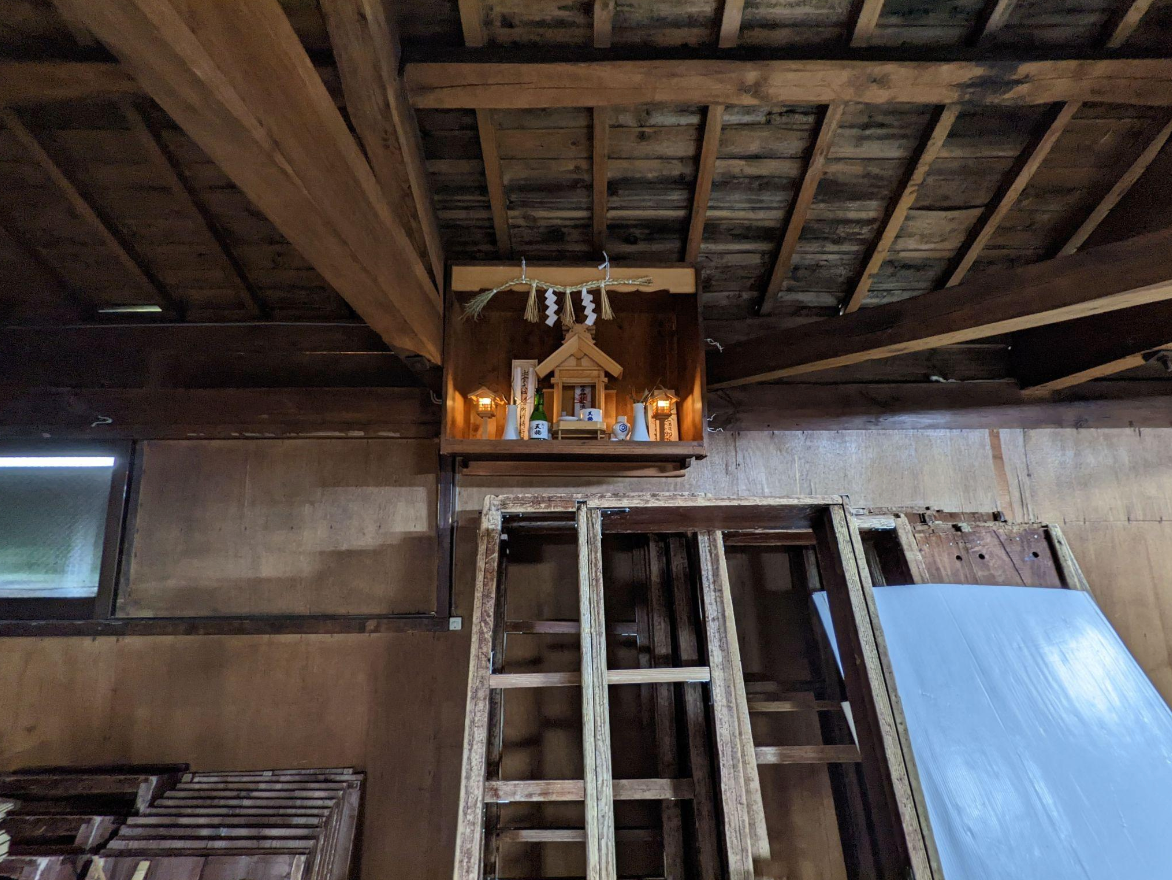
There are 4 breweries in the smallish city of Izumo and all of them supply sake to Izumo Taisha. Providing sake to the shrines where sake originated, to honor the gods that first made it, that's a huge responsibility. This in tandem with the foggy cold climate means you find a culture of brewers here that take their work very seriously and a style of sake that is suited to age and serving warm. Somehow, the region has largely escaped the pull of hyper-aromatic, fruity-juicy ginjo brewing and leaned into something more subtle. Given how disconnected this region is from the rest of Japan, producing sake for the local market is far more important than aiming for Tokyo trends or international appeal. Here, I visited only Asahi Shuzo and Itakura Shuzo but in both cases the philosophy was very much their own. These are also among the very few breweries I've been to where the toji could recount the name or identity of the deities that inhabit their brewery shrine– always a fun question.
Japanese sake is brewed as an act of prayer: an offering of gratitude for the abundant harvest, made to nature, to the gods, and to one's ancestors for the gift of rice.
That sake, imbued with the prayers of the people, is called omiki (御神酒, sacred sake), and has long been considered the highest offering that Japanese people present to nature and the divine. We believe that omiki — sacred sake — is the very ideal that Ten'on and Mukyuu Ten'on aspire to.
Ten'on and Mukyuu Ten'on pursue a sake quality that is pure, gentle, and serene, and we wish to create a sacred sake that brings calm to the hearts of those who drink it.
When all of the gods meet at Izumo Taisha once a year to discuss en– the connections and relationships between people– and how their en should change in the coming year, they do this while enjoying sake as it's a natural way to diminish our ego and be reminded of our connections clearly.
Sharing sake with another person is also a form of gift-giving. Here is an interesting observation: gift-giving creates a relationship with another person even when no relationship existed previously. Pouring sake for another person is giving them a gift, creating a relationship, creating en. In his blog, Kojima named the path of en formed through gifting — the connection itself — nag.
According to Kojima, sake was once more connected to art than a mere beverage: it was a concrete embodiment of concepts like gods and nature that ordinarily can't be perceived through the five senses. Sake was a physical manifestation of these abstract ideas. In this way, sake gained social significance and became traditional art.
But in modern times, with capitalism and the defeat in the war as turning points and the march toward globalism as the driver, Japanese people gradually started to lose their sense of identity and their conceptual, spiritual world. Sake transformed from art into craft and product, becoming a connoisseur's item, a hedonic drug, or a commodity within the real world — needing very little of the conceptual world at all.

He sees the current state of sake as an accumulation of all these past characteristics, layered like strata. None of these is "better" than the others, and a given sake might over or under-index a given stratum.
- 5. Sake (the original) … Art
- 4. Omiki (sacred sake) … Traditional art
- 3. Jizake (local sake) … Traditional craft
- 2. Sake as alcoholic beverage / connoisseur item … Craft
- 1. Sake as capital / market product … Product
Kojima's goal is to create sake that reaches toward art, traditional art, and traditional craft by resonating deeply with the drinker and putting them in a social, giving, non-egoistic state of mind, which helps remind them of the connections they have with others.
…We often say that drinking alcohol creates connections, but perhaps it would be more accurate to say that drinking alcohol makes us realize that we are already connected. If we drink alcohol and amplify our desires and egos, those connections disappear; but if we drink alcohol and empathize, those connections naturally emerge.
Our sake brewing has always followed the concept of Engi. Engi is based on the idea that everything is already connected– that all things and events come into being as a result of relationships that have always been there, like invisible threads. This view assumes that existence itself is interdependent: me, you, the tree, the rice, the mushrooms beneath the ground. Every happening arises through these existing connections. Nothing can come into being, nothing can happen, without interdependent relationships.
If you want to explore and understand sake, you have to clearly separate sake's conceptual existence (traditions, history, personal flavor notes..) from its reality (rice, water, koji, 16% ABV, etc.) Sake's concept is tied to cultural tradition and subjective flavor; sake's reality is tied to brewing technique and chemical composition. And it's preferable that these two can travel back and forth between each other without contradiction — that is, that they are connected (nag).
When you drink sake with someone, you'll see contradictions like taste, personal memories, different perceptions of sweetness and bitterness, personal opinions-– individual concepts and worldviews— that will never converge. At the same time, when drinking sake together you can also experience the sensation that the contradiction of "you" and "me" has become identical — finding common ground. That means we recognize each other by searching, through the real act of drinking together, for shared concepts. The result is that sake can do both — it can divide us or connect us.
To Kojima, this realization gave rise to his sense of purpose at Itakura Shuzo. "If at all possible, I'd rather make a sake that reminds you of connection than one that makes you aware of division... I, who was given the love of brewing technique by those who came before me, feel I have to answer YES to this will-to-meaning that arose from my own conceptual world." He must create a nag– a living connection- between his conceptual world where he unravels these ideas and the real world where he brews sake, to communicate his ideas to you clearly.

^(You're gonna need to use google translate for this one)
Sake has a tendency to be subdivided and pushed toward fragmentation [rice only, junmai, honjozo, ginjo…-N]. But if, going forward, we could broaden the category of the Saika we brew — from Saika, to a Saika for Japanese people, to a Saika for all humanity, to a Saika for all living things, for soil, for natural life — and if we could brew a Saika that reminds us of Engi: already-existing relationships and connections, then that endeavor would transcend the nature of alcoholic beverages and become something meaningful for all of humanity.
This brings us to the sake he makes with this concept in mind. The sake you have in front of you: Mukyu Tenon. It's a beautiful label, truly– one of my favorites– and he goes into detail about how he recommends you enjoy it here. But I think most of all, Kojima-san would want you to share it with someone.
Mukyu Tenon Sakanishiki Kimoto Junmai Daiginjo BY5
Written by Tatsuya Kojima, translated by Claude AI with adjustments
Aroma: The distinctive aroma of Mukyuu Ten'on — estery, sweet rice-koji fragrance, warm notes, grassy alcohol aroma.
Palate: Pure and clean, smooth, fine-grained sweetness, ginjo-style acidity with yeasty apple and grape notes, lactic acid weaving through in a sensual way, fine alcohol presence (finesse), the taste of water, minerality, lingering length, koji umami and sweet finish.
Currently best enjoyed chilled, cold, or on the rocks. The mid-palate ginjo character and acidity open up and strengthen. Pure and delicate with a juicy freshness, yet complex and powerful. Within the "clean and pure" category, this sake encompasses taste preference, artistic expression, and tradition all in one — an orchestral quality. There are temporal dimensions of youth and aging, but beyond those, what I felt was that the truly important elements and their interrelationships exist within this liquid.
In terms of taste, it is a pure sake with low glucose and low amino acids, yet the L amino acids from koji and the D amino acids from lactic acid bacteria provide sweetness, and these are layered with organic acids from yeast and lactic acid, various aromas from the association yeast, smoky, woody and spicy notes from wild yeast, and minerals from mountain water. Because it is low in glucose and amino acids, it contains fewer substances that interfere with aging, so it's likely to age gracefully.

Tenon Sauvage Tsuchigumo: Earth Dive Spider
(Note: NOT included in May club due to cost limitations but available for purchase)
Written by Tatsuya Kojima, translated by Claude AI with adjustments
This is the "wild" Ten'on series — Saika-ara– and since Amagumo ("heavenly clouds") is the original brand/batch that it was supposed to be, this aberration was named Tsuchigumo ("earth clouds" / earth dive spider). Thank you so much for the tremendous response and the many repeat orders we received for Sakeru (a BY4 aberration that arose from a bad Mukyu Tenon batch)— it truly saved us. Where Amagumo was conceived with the image of drifting through the heavens, Tsuchigumo was named with the image of an earth-diver burrowing through the ground, drilling through geological strata in search of the ancient and the primordial — and of the tsuchigumo (earth spider), a creature imagined to inhabit the buried, primitive world.
Tsuchigumo is a sake in which the same phenomenon occurred as with Sakeru (another aberration, BY5): lactic acid bacteria, which would normally die off once the alcohol concentration rises to a certain point, instead developed alcohol resistance, survived and multiplied, and carried out lactic acid fermentation throughout the sake. It was not a sake born by intention, but it has a compelling, almost insistent appeal — as if it has something to say. And I think those who have tasted Sakeru will understand: even when the acidity climbs this high, the fundamental aromas and flavors of my brewing — and the spirit behind them — do not disappear from the liquid.
Just as Sakeru carried the character of Saika, Tsuchigumo carries the character of Amagumo. The acidity is lower than Sakeru, with a softness, richness of umami, and depth of flavor that can be felt. It has a deliciousness distinct from the sharper, more cutting Sakeru. I think you may also sense a kind of sibling relationship — a front-and-back, mirror-image pairing — where Sakeru is Mukyu Tenon Saika, and Tsuchigumo is Amagumo.
From a brewing standpoint, what is most fascinating about this wild sake is that yeast fermentation and lactic acid fermentation are occurring simultaneously. I was able to experience very powerfully the cleansing force of yeast rest — the way yeast adsorbs and purifies the negative byproducts of lactic acid fermentation. The composition of organic acids only shifts toward more lactic acid, so it does not appear to involve an increase in the kinds of harsh bacterial acids that would make the sake undrinkable.
If we look at this through the lens of the soil-formation mechanism I described previously — that this is simply the San'in Ginjo base expressing itself honestly, with lactic acid fermentation layered on top — then perhaps it represents one vision of the near future of natural fermentation in Japanese sake.
While these sakes are delicious, we will work to apply what we have learned in a positive direction, so that unintended results like these do not happen again. Listening to your impressions, I intend to reflect carefully on what this phenomenon — and this failure — is asking of my sake brewing going forward.
DETAILS: R5BY Tsuchigumo — Second Pasteurization (2-hi) Kairyo Omachi 60% | Kimoto | ALC 16%
With the first-pasteurization (1-hi) batch now sold out, we are releasing the tank-stored 2nd pasteurization (2-hi) version of Tsuchigumo. This release will mark the end of Tsuchigumo. Despite being such an unusual product, customers introduced it to others and made this final release possible. We are deeply grateful.
Aroma: Soft fragrance, lactic acid, acidity.
Palate: Soft entry, lactic acid, acidity, sweetness, a faint 4-methyl green note, pineapple-like aroma, bitterness, pleasant lingering bitterness (horo-nigasa), clean finish, simple yet full-bodied flavor. Simply delicious — like a pineapple wine. Softer and with a stronger impression of sweet umami than the 1-hi batch; the acidity has settled and become more mellow, and the overall balance has improved greatly. The acidity is of course still strong, but it is cohesive, so it doesn't feel out of place. The aging shows no deterioration (hineka) — instead there is an interesting sense of maturation in the pleasantly bitter aftertaste. The alcohol is also hard to perceive. Even with elevated acidity, the sake's fundamental character is sound, and through aging it is gradually becoming more and more like a proper Japanese sake.
R5BY: Kojima's Reflections

Written by Tatsuya Kojima, translated by Claude AI with adjustments
R5BY Sakeru and Tsuchigumo were enormously significant events, and processing everything they brought required a great deal of effort and emotional energy. But with the passage of time, I have come to feel that they gave us something very large in terms of learning.
Sakeru and Tsuchigumo taught me the true nature of fermentation as a natural phenomenon. They also showed me that even when the acidity climbs this high, the character of my ginjo brewing remains firmly present in the sake.
For those who have tasted them, I believe you can understand that these are a pure expression of the fusion between human craft and wild fermentation — one form of natural fermentation, in which the elements of the brewing I have practiced are clearly present.
In terms of the concept of natural fermentation, it is clear that Sakeru and its kin exist beyond sake as we know it — as sakes that satisfy the modern human desire to connect with natural life.
I believe the key may lie in the D-amino acids produced by lactic acid bacteria. These amino acids are still largely mysterious, but the history of fermentation in which humanity has made use of D-amino acids already exists. I feel that water-moto starter and sakes like Sakeru, which contain these in great abundance, will continue to cut to the very essence of fermented beverages. And I am increasingly certain that these amino acids are shaping what we might call shared human emotion — through the transmission of information and memory.
It seems as though humans build their physical bodies from the amino acids of other living organisms, and share memory through the amino acids of microorganisms and bacteria. Fundamentally, a person fulfills their role in the current of natural life simply by breathing, eating, and excreting.
Sakeru and Tsuchigumo gave existing drinkers a jolt that forcibly expanded their frame of reference, and also drew in entirely new ones. Even younger drinkers understood it simply as delicious. Looking back now, these sakes gave us something so large that I can no longer measure it in terms of good or bad.
This final Tsuchigumo release feels like it has helped me process a great deal. The times, too, have shifted significantly. Having passed through classical San'in Ginjo, natural fermentation, and the Sakeru/Tsuchigumo experience — I intend to keep thinking about what kind of sake to brew in R7BY, and what path to take.
Key terminology
- Nag (ナグ) — Kojima's coined term for the invisible "path of connection" that runs through all things. He treats it as the binding principle behind en, dark energy, vacuum energy, and quantum field effects all at once.
- Itonami (イトナミ) — ordinarily "activity / livelihood / continued operation-" it can imply daily life, sex, chores, routine, or the accumulated effects of them. Kojima uses it as a key term for the ongoing weave of natural life.
- Saika (齋香) — Kojima's idiosyncratic reading. Literally "purified/ritual fragrance." He uses it as his preferred word for sake-as-sacred-substance, distinguished from seishu (清酒, the legal/commercial category) and from generic sake.
- Saika (齋香) vs. Saika Kō (齋香荒) — In Kojima's lineup, Saika is the "complete" version of the brand: clean, balanced, fully realized. Saika Kō is the "rough" version — when a batch ends up wilder, more acidic, or otherwise off the target profile, it's released under the Saika Kō name rather than discarded or forced into the Saika spec. This page is the redo batch that succeeded as Saika after the season's first attempt had to be released as Saika Kō.
- Omiki (御神酒) — sacred sake offered to kami.
- Tsuchigumo (土蜘蛛) — literally "earth spider." A name from Japanese mythology for pre-Yamato peoples; here used as a sake product name, paired with the Paleozoic / muddy-water layer.
- KODANE / Itonami Mead / Saika Kō — Ten'on's experimental product lines that map onto Kojima's evolutionary strata.
- Sakanishiki (佐香錦) — Shimane Prefecture's local sake rice, developed at Shimane's research stations from a Yamadanishiki × Kintōji cross. Named for Sakanouchi/Saka Shrine area, the legendary birthplace of sake brewing in Japan. Okuizumo (奥出雲) is the inland mountain region where this batch's rice was grown.
- R5BY — Reiwa 5 Brewing Year, the brewing season running roughly July 2023 to June 2024.